Passing Big Exams: Applying Psychology & Neuroscience
A resource for anyone facing the CPA exam, EPPP, Bar exam, PE/FE, MLE or any other major career-defining test
I started writing this for a lovely cycle-breaker and working-parent who is studying for the CPA exam. The more I thought about it, though, the more I realized that many of us face a Big Exam at some point. I’ve worked with fellow therapists and providers who are studying for their EPPP, MLE or nursing exams. Engineers take the FE or PE. Architects sit for their ARE. Lawyers study for the Bar. Servicemembers and servicemembers-to-be whom I’ve supported have prepared for exams like the ASVAB or DLAB as well as major performance qualifications. And accountants and financial advisors like the person who inspired this post are navigating the CPA exam or FINRA series. The exam changes but the experience of preparing for it - the pressure and stakes, the self doubt, the exhaustion, the strategic rallying - is something we share.
There are also ways that some of the findings and tricks we know from the psychology and neuroscience of learning, memory, and performance can be helpful when applied towards improving your mindset, study strategy, and exam-day performance. Whatever exam you are facing, this is for you. I hope you will find this resource helpful.
First, let’s get perspective.
Before we talk strategy, let’s consider where you are right now.
These exams are hard - hopefully not because our institutions want to see us struggle or get money from us, but because the credential we have is meant to communicate certain demonstrated skills and learning. I used to remind myself that my qualifications exams, dissertation, and licensing exam were related at least in part to the importance of building and earning trust as therapists. As a CPA, lawyer, engineer, etc. there is an importance for public trust as well.

Here are some questions you may want to ask yourself:
- Why are you taking this exam? What do you hope this will do for you or your career? What may passing mean for your life, your family, or the things that matter to you?
- What are reasonable expectations for your Big Exam? Sure, we all want to pass our Big Exam the first time, but let’s start by grounding ourselves in the numbers. What score do you actually need to pass, what does the data say about how people tend to do on the exam you’re taking, and how many chances do you get? For instance, the CPA exam has a national pass rate between 45 - 55% per section and only about 25-30% of candidates pass this the first time.
- In what ways can you find a supportive community? People have faced this before you and are currently facing it with you, so what sorts of resources, practice tests, study groups, or other social support you can lean on? You don’t have to do this all by yourself. Are there people you can share your goal with, celebrate with, sit with while studying for morale support, or who can help you with other things so that you can have more time for study and rest during this time?
- What do you still have, regardless of the outcome? This one may sound strange, but I do have a reason for this. When we focus on exams like these, they can start to feel so massive not just for our career but even for our self worth, future, and identity. It can help to notice the limits of your Big Exam’s impact as well by considering what is not at risk here. What are some things in your life that you will have whether or not you pass (e.g., a loving partner, your relationships with your kids, your history of scrappy resilience, your best friends, your awesome sense of humor or creativity, etc.)? Before you go further in strategy, you can help ground yourself by listing these out. “No matter what happens on this exam, I will still have…” This exercise can take some of the existential weight off of our test score. We want to be motivated certainly, but chronic and severe stress can hinder rather than help your performance.
Understanding Anxiety: Your Brain on High Stakes
Nervousness before and during your Big Exam is normal and even helpful to a degree. Your anxiety is pointing out that this matters to you. A little anxiety can be activating - it can wake us up, sharpen our focus, and remind us of why we are doing this. I have often told my clients and students about the Yerkes-Dodson Law. These researchers found that there is an optimum level of arousal or stimulation for performance on different tasks.
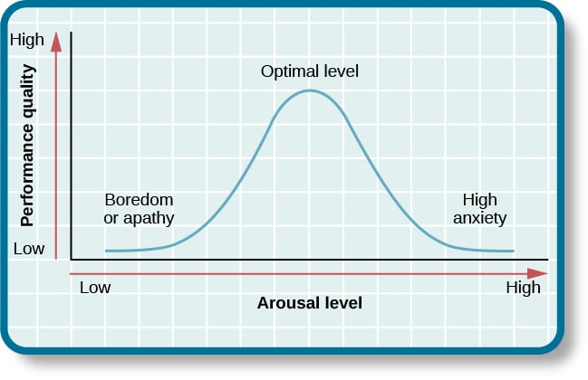
For easier tasks like reading notes or studying more straightforward things, it can help to have some additional stimulation to help our performance. Sometimes people put on music in the background or bring in social facilitation (also sometimes called body doubling) by studying with a group to help add more stimulation and keep motivated. For more challenging tasks such as thinking through complex practice questions or taking the exam itself, most fare better with low stimulation (a lack of distracting sounds or sensations, lower stress level, less worries racing through our head).
A lot of anxiety can hinder our performance or even cause us to freeze and forget. If you’ve had the experience of knowing something during a practice exam, remembering it after you leave the room, but blanking on the exam itself, anxiety was probably the culprit.
Cortisol (the chemical released when we are stressed) also impacts how your long-term memories are both encoded (taken in and stored during studying) and retrieved (pulled to the surface for application during the exam). When your anxiety is spiking, you are not only losing a portion of your attention and mental resources to those worries, but are also disrupting the process through which you bring memories of relevant concepts you’ve learned back to the surface of your mind (into your working memory) so that you can apply it to the problem at hand. Acute stress (short bursts of tension) can help us remain alert and motivated, but severe or chronic stress can impair our memory, functioning and performance over time. Feeling nervous about your exam is normal and fine, so long as we keep that stress/anxiety in moderation.

Bottlenecks to Keep in Mind
In your learning and memory process for the Big Exam, there are four main bottlenecks worth understanding:
- Attention. We can only pay attention to so many things at once. When we have a lot going on or a lot of information coming in, our minds will typically prioritize things that are potentially threatening first. If negative or fear-related thoughts are showing up (e.g., worries about failure, money, career barriers, imposter syndrome), your brain treats those as more urgent, routes attention to them first, and draws resources away from the material you are trying to absorb.
- Working Memory Capacity. We can only keep so many pieces of information in active working memory at a time. Your worries and fears take up critical space here, leaving less for the topics you are trying to understand, remember, and apply.
- Memory consolidation. Stress negatively impacts sleep and rest, and sleep is when our brains consolidate much of what we have been studying into long-term memories. Research has consistently shown that sleep is important for long-term memory of what you are studying. Depending on your sleep schedule, having protected rest or sleep may be more important than taking another practice exam this week.
- Retrieval. Our final bottleneck is during the exam itself. You’ve done the work but under high stress, retrieval can still be impacted. If you’ve ever experienced that “tip of the tongue” feeling where you know that you know something, but just can’t reach it, that is a failure in memory retrieval. Stress can disrupt retrieval and also impact how you are thinking during the exam. Stress can push us into more rigid, habitual thinking and away from more nuanced, flexible reasoning that many of these exams require.
The good news is that all four of these bottlenecks can be addressed through deliberate strategy. Understanding how your brain takes in, stores, and pulls up information can help you develop your exam strategy more intentionally.

Mindset: The Mental Game is Real Here
Sports and performance psychology have long recognized that improving our performance is as much about the mental game as it is about preparation and practice. The same is true for your Big Exam. We can draw from the 5 C’s in performance psychology when thinking about this.
Commitment. This one is about setting up a predictable and consistent schedule, protecting breaks, and approaching your goals gradually and steadily. Commitment isn’t just about studying, but about protecting the schedule and conditions over time that can make your studying more effective.
Communication. Checking in with your support system and asking for support is so important here too. You can tell your loved ones that you are working on this exam or setting aside time for reading, studying, or practice. You may even find it helpful to talk to them when a topic is frustrating or causing you difficulty for emotional support or even an outside perspective. It can feel nice to talk this through with loved ones, with a support group of people who are going through the exam as well, or others in your field. Sometimes we get messages from society about how our success or passing of these exams can speak to our worth, or how we compare to others (e.g., are we “good enough” or “imposters”). These can prevent us from getting helpful support.
Concentration. We can apply what you know about optimal arousal (Yerkes-Dodson Law) and apply stress management and mindfulness tools to help improve concentration during study sessions and the exam itself.
Control. By letting go of things you will not be able to control (e.g., what exact questions will or will not come up, systemic concerns in your field that impact this exam and your career, the possibility of some unexpected thing happening on the exam day), you can save your energy for what you can actually control (e.g., your strategy, preparation, habits, and self-talk).
Confidence. You have seen yourself do hard things and come out the other side. You have shown resilience, evidence of growth, and have learned and passed exams in the past. It can be helpful to remember evidence of your own competence and build an affirming yet accurate basis for confidence in yourself on this exam. It can help to even list out things you have seen yourself succeed in, strengths you know you bring to this, and some of the things you can see that you have learned or improved in since you began studying. Confidence is about strategic affirmations and reminding yourself of your progress. This is important because when we are focusing on growth or improvement, we can forget to give ourselves credit for how far we have come. In doing so, we can discount our own strengths and leave room for self doubt to creep in.

Some affirmations you may want to consider are:
- “I am not failing. I’m learning.”
- “A score is data, and data tells me where to go/focus next.”
- “Every person who passed this exam was once right where I am now, studying and learning the material.”
- “I have done hard things before.”
The best affirmations are ones that you create yourself, that line up with your own values and the worries you know tend to show up for you personally. You can reread your affirmations before or after study sessions, practice exams, and the Big Exam itself.
What the Research Says About Who Passes
Researchers (Dickens, Hull & Quick, 2021) looked at CPA exam study methods, for instance, and found that the most effective method of study for people on this exam was practicing problems. The specific study habits people used were found to be more important than whether or not a person took instructor-led classes or spent a particular number of hours studying. For the CPA exam, researcher found that study habits were more predictive of exam performance than even GPA, demographics, or academic background. This is encouraging for people taking it or retaking it - it means that the biggest predictive factor in your success is something within your control.
There is research generally that shows that those with improved academic performance, higher GPAs, and degrees from accredited programs show higher pass rates on Big Exams, but this is likely due to the shared behavioral strength of being able to commit oneself to consistent, structured, and rigorous training over time. It appears to be more to do with your ability to keep studying, applying yourself, and approaching the material than trait intelligence.
This also fits with findings in learning and cognition. Bloom’s taxonomy outlines a hierarchy in learning. At the base are remembering and understanding (such as knowing a definition or restating a concept). Higher up we then have applying, analyzing, evaluating, and creating (using concepts to solve problems, distinguishing relevant and irrelevant information, and exercising judgement in ambiguity). Practice problems can be a great way to prepare your brain to think not just in definitions but in applied scenarios.
Reading, flashcards, notes, and visual concept maps can be great options for remembering and understanding the concepts. Most professional and licensing exams expect us to take that to a higher level as well, though. The CPA exam has task-based simulations, the EPPP has applied vignettes, and the Bar has fact patterns, all of which ask you to apply the material rather than just recall it. Practice problems train us to engage with the material at this higher level.

Research-Backed Study Strategies
Spaced Practice and the Forgetting Curve
Psychologist Hermann Ebbinghaus found that we forget new material quickly after the first exposure, but that our forgetting slows after each new exposure. You can see this in the Ebbinghaus Forgetting Curve:
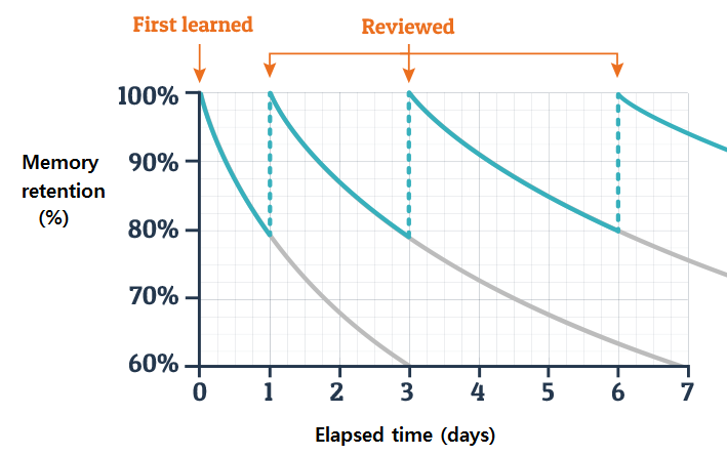
In practice, this means spreading out your topic reviews across your full study window. If you are covering topics A, B, and C this week, those same topics should be revisited in the following weeks at least briefly as you add new material. You aren’t relearning it so much as refreshing your memory and reinforcing past learning. This repetition (retrieving the information again and again) helps deepen the learning from short-term memory to more durable long-term memory.
Interleaving and Intentional Variety
Robert Bjork (a fellow psychologist and fellow Minnesotan) researched “interleaving” or mixing different subjects in the same study session rather than drilling on a single subject alone. The mental effort it takes to switch to different topics may feel a bit inefficient at the moment, but it can also lead to a different sort of deeper processing and pattern recognition. This can help you notice connections and contrasts across different topics and concepts and better resembles the random assortment of questions and topics that will come up when you are actually going through exam questions. You could do this through brief daily quizzes for instance. If you spend 15 minutes on a set of 3-5 questions spanning different topics at the same time each day, you can create a steady practice of training your brain for retrieving information across the full spectrum of content you are studying.
Considering Cues and Context
There are some fun complexities here. We form associations between what we are learning and the context in which we are learning it. We also refer to this as state-dependent learning. You are more likely to recall things when you are in a similar state and mood to when you learned it. You may therefore find it best to anchor in the state in which you perform best. For me, that tends to be when I am a combination of peaceful and caffeinated. I focused on certain rituals and routines when studying to take advantage of state-dependent cues. Specifically, I completed brief mindfulness exercises for a few minutes before study sessions and practice tests as well as before the exam, before my dissertation presentation, and before clinical or research days. I also tend to drink coffee each day so on both study and exam days, I had my usual cup of coffee beforehand. What routines and states do you work and perform best in? Is there a way to bring in elements of this for both your studying and your later application?
Although we better remember things when we have environmental and other cues, your exam will be a different setting than when you studied. The lighting, seating, sounds, and even smells will likely be different. This is likely why psychologists Elizabeth and Robert Bjork recommend training yourself to retrieve this information in a variety of settings. In other words, though keeping our mental state as consistent as possible is helpful, it can be helpful to vary our settings. This could mean studying a little at work, a little at your dining table, a little at a coffee shop, and a little in a quiet office space.

Active Recall and the Testing Effect
Some of the clients I’ve worked with describe spending hours reading and re-reading. One of the worries I expressed was that when we reread things, it can lead to that material feeling familiar, and us seeing that familiarity as greater progress than it may actually be. There may be some passive recognition on the exam itself, but most likely you will have to apply a more active memory of the material. To better fit your studying to its purpose for your later exam and career, consider more active techniques. For instance, during a review you could write down everything you can recall about a topic from memory and check what you recalled or missed. This can be more active than passive re-exposures through reading. Brief daily quizzes, flashcards used actively (meaning you don’t look at the answer until after you’ve tried to answer it yourself), and practice problems all help practice retrieval to build memory.
Making Meaning
We tend to think in stories and meaning. This comes up a lot in therapy, but it can also be important for learning and memory. Stories and context help us understand and recall concepts. When you are studying, you can use this strategically by taking abstract concepts and grounding them in meaning. Think of specific examples, situations, or people you can associate a particular concept with. An imagined client, scenario or character can help. You can also practice meaning making by imagining how you would explain this concept to a curious client or patient in your eventual career and practice. How would you explain this so they can understand the “what” and “why” of it? This works because our memories are so narrative in nature. We remember stories, relationships, and cause-and-effect better than abstract rules or concepts.
The Feynman Technique
This is a technique for deepening our learning, named after physicist Richard Feynman. The key idea here is that we can enhance our understanding by imagining that we are teaching this topic to someone with no idea about it. It pushes us to have to explain our thoughts fully, use different terms perhaps than we normally would, and even helps us identify our own gaps in knowledge.
Pick a topic - a specific case, concept or scenario ideally. Explain it out loud. If you want to truly follow the Feynman Technique you can teach the concept to a child. For the purposes of deepening your understanding, though, it’s also okay if you want to practice explaining it to a person you know who is not in your field, or even to an object. I think of the delightful chats my toddler has with her little stuffed animal goat, Douglas. The interaction of a real human is best, but if you also just need to get yourself to imagine an audience, feel free to set your version of Douglas on a chair in front of you and begin.

When you struggle to explain certain parts or stumble, this is where you can focus on growing your understanding. The nice part about this technique for studying is that it’s harder to hide what we don’t know when teaching it. If there’s a gap in our own knowledge or understanding, this helps us find it. If you are speaking to a human rather than a stuffed goat, you also can get feedback. The person can ask questions and help us get practice explaining this in different ways or using different examples. This is another way to practice and study in ways that convert passive familiarity (recognizing something when you see it) into deeper understanding (being able to generate and apply it).
To help make this learning even stickier, you can try to make it memorable. I’ve told a client studying particular accounting concepts to imagine explaining these as if your client were a mob boss, or to make it interesting by explaining it in both English and Spanish, for instance. These are not quite the Feynman technique, but they are additional ways you can engage in active learning and meaning making as you study.
Error Journaling
Did you know that guessing incorrectly when quizzing yourself can actually improve your memory later? I’ll be honest. I had heard people tell me throughout my life that I learn more from my mistakes or more from failures than successes, but had wondered if that was just something we tell ourselves while learning to be scrappy and resilient in a capitalistic and oppressive society. Really though, we do learn better when we let ourselves get it wrong and use those wrongs as steps to greater understanding. If you go through flashcards, brief quizzes, or brief practice questions/vignettes of scenarios and find afterwards that you missed the mark, this is a great opportunity in your studying process. Psychologist Veronica Yan and her fellow researchers at the University of California found that participants who guessed at answers for word pairs had better recall than those who simply studied the correct pairing. Applied psychologists Lindsey Richland, Nate Kornell and Liche Kao took this a step further and studied students reading essays and preparing for tests on these. Those who guessed answers to practice questions first did better on the final test. This is likely the rationale behind why textbooks now often have sections at the ends of chapters to “test your understanding” with brief review questions. The benefit comes from guessing and then checking to see what the actual answer is.
When you get something wrong on a practice problem or exam, you can write out the rationale for the correct answer. This is most helpful if you can briefly note what you thought the answer was, what it actually was, and why that answer is actually the correct answer. We often repeat the same errors across exams, so being able to journal why we want to think about the answer a certain way helps us further emphasize the way of thinking we want to practice, better remember the topic we missed a question on for the future, and gives us a journal we can review as we want to in later study sessions.

Taking Care of Your Brain
We all have a wonderful capacity to learn. At any given moment, we are taking in new information and learning and making new connections in our brains. This works even more effectively if we take care of our brains.
Sleep
This is probably the most important self-care variable for performance, and also the one we most often sacrifice. Research has supported that sleep after learning can strengthen new memories. Sleep deprivation also negatively affects our memory, including procedural memory (how we work through problems or apply concepts) and declarative memory (recalling definitions or names of concepts, terms, or figures). Aim for consistent sleep periods and try to avoid late-night cramming before the test as that can undermine the memory you’ve spent weeks or months building.
Nutrition
There is some research to support that B vitamins such as B12 and folate (B9) may be involved in the production of neurotransmitters associated with mood, motivation and cognitive function including serotonin, dopamine and norepinephrine. Deficiencies in these have been associated with poorer memory and cognitive performance. Choline is a precursor to acetylcholine, which is a neurotransmitter important for learning, memory and sleep. Vitamin D’s effects on learning and memory appear mixed in the research, but can be generally supportive of mood. Hydration, omega-3 fatty acids, and consistent meals also appear to matter. Your brain runs on glucose and its performance is sensitive to what you feed it.
Movement
Maintaining your regular movement, activity or workout routine can also be helpful. Studies have found that exercise improves cognitive function so maintaining or even mildly improving your health through exercise can be helpful. Myself and fellow psychologists often coupled our studying with movement, such as listening to lectures while walking or working out on the elliptical, going through flashcards while breathing and doing yoga, or explaining certain concepts to our partners while we were doing chores or cooking.

Stress Regulation
Brief mindfulness practices for even five minutes per day can have a positive impact on stress, mood, and attention. Mindfulness exercises before study sessions or your exam can have meaningful impacts on anxiety and working memory. Deep, deliberate breathing also can activate our parasympathetic nervous system and reduce that cortisol spike that can impair memory retrieval. Building brief mindfulness exercises into your routine will likely not only help you for this exam, but more generally for your mental health and awareness.
Going through practice tests or even the actual exam, only to earn a score that doesn’t pass can be a devastating experience. You are investing months of time, probably an amount of money on materials and the exam itself, and are doing this in the first place because the outcome matters to you. Many of us remember the pressure, endurance, and repeated practices as challenging and at times overwhelming. It’s okay to not only focus on the materials and strategy for practice, but also what you need emotionally over the course of your studying and test taking. Coping with the emotional significance is part of this process too. This is where the ideas about keeping perspective, 5 Cs, and social support mentioned earlier in this post can be especially helpful.

Final Thoughts
You are doing something that is both challenging and meaningful. Many smart, capable, hard-working people came before us and also found these exams hard. Many people just like us poured over the material, took practice tests, did breathing exercises, and eventually passed.
If your scores on practice tests or past exams have not yet crossed that finish line, this does not mean that you are not smart enough or deserving of your goal. I’d encourage you to treat it as a single data point in a far larger process. If you take anything from this long post, I hope it’s that our performance on these Big Exams comes down to strategy rather than ability. The gap between where you are now and where you want to be is your strategy. You have achieved so many things before this Exam and you will achieve many things after it. This is about giving yourself the best practices, conditions, and cues for success.
I wish you the best of luck and hope this resource was helpful!
Please note:
This is meant to be educational. This is a summary of some interesting research findings and techniques we know of generally in our field (to the best of my current knowledge as a psychologist), but this article is not meant to serve as personalized medical or career advice. If you would like personal support throughout your process to work through the feelings, thoughts, strategies, stakes and anything else coming up, please also feel free to reach out. You can book a call with me if you'd like to feel out whether us working together would be a good fit for your needs. If it sounds like us working together could help you in this process, I'd love to be the Samwise to your Frodo on this journey!