The Strong One, The Overfunctioner
Give Her All the Heavy Things We Can’t Shoulder
By Dr. Jacqueline Layton, PhD
Mockingbird Therapy
The first time I watched Encanto with our girls, I was hit without warning by Luisa (the older sister with the super strength) when she sang her solo. I read somewhere that Lin-Manual Miranda wrote this song as a love letter to his own older sister whom he watched carry the burdens of the “elder sibling” role.
Whether you were the high-achieving, care-giving, conflict-mediating older sibling now all grown up or whether you fell into a role of being the one who does the fixing, the problem solving, and the load bearing later in life - the pressure of carrying too much is something many of us know all too well.
This theme comes up in the therapy room again and again. I have been lucky enough to work with such amazing clients, many of whom have found themselves in this Super-Strong Overfunctioner role.
And there’s systemic reasons for that as well that are often left out, so I’ll get to that as well in this conversation. If we struggle to count on others or on systems, and instead push ourselves to do more, achieve more, care more for others - eventually we reach a point where the things collapsing around us are too big for any one person to solve.
I think that’s a big part of why so many over-functioning, high-achieving, caregiving folks are coming in for support now. They are seeing the rates of childcare rise. And even if they are working hard, our incomes have risen at less than half the rate that our cost of living has risen in recent years. As systems come crashing down on us, those of us trying to carry it all are feeling it early.
To start, though…
What is a Super-Strong Overfunctioner?
If this is you, you are probably known as a “fixer” and “the one who handles things.” The one who can be counted on to get things done. You probably push yourself to try to keep doing well, meeting responsibilities, and showing up for others even when you are tired, overloaded, or overwhelmed.
And that you’re probably a person who has been seen as a hard worker, but perhaps also someone often in control (or who struggles to let go of control).
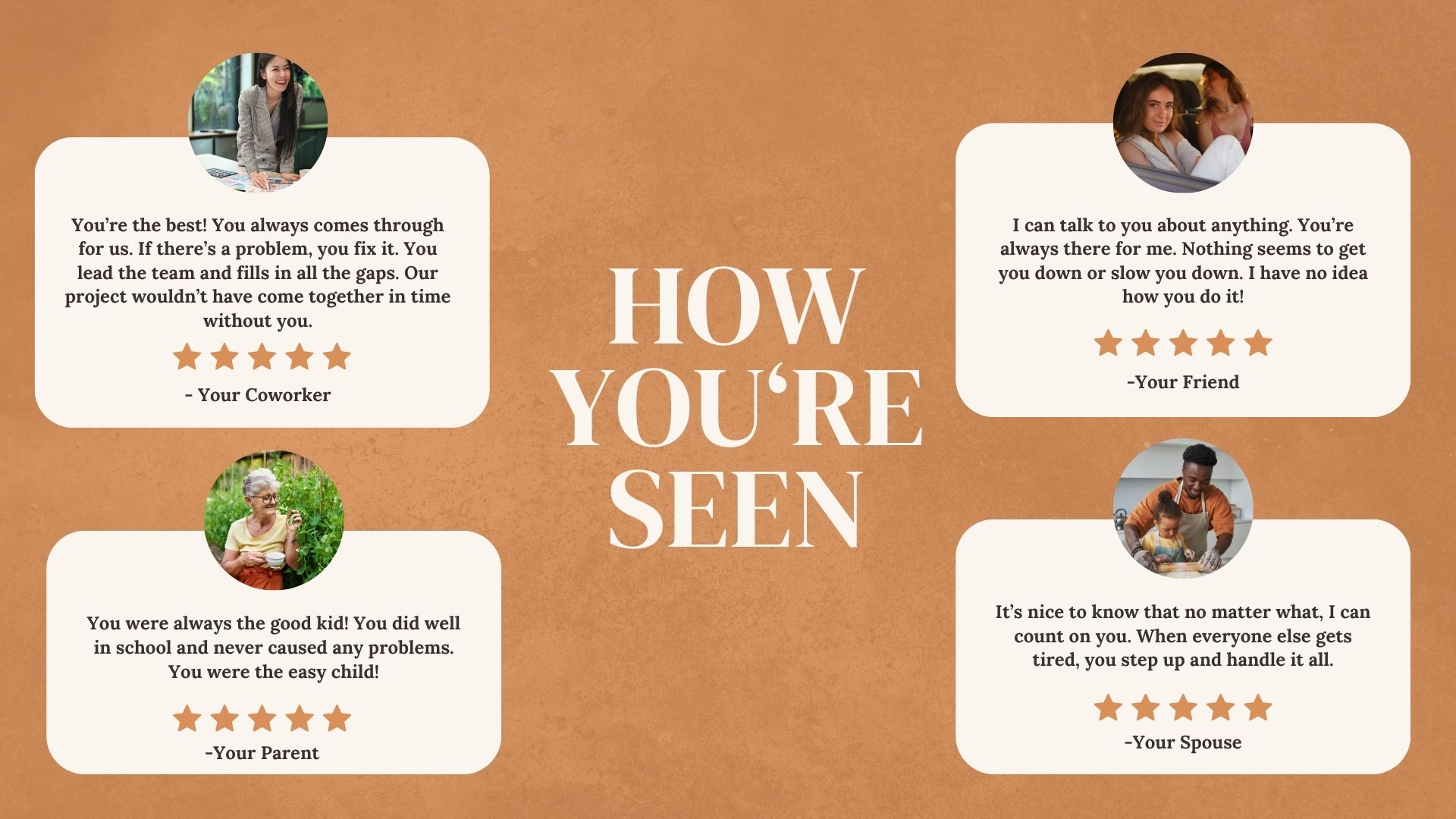
Overfunctioners become “overresponsible” for family, friends, or coworkers to the point of at times managing their own anxiety by taking control of plans, situations, or even micromanaging others. We have our reasons for learning this pattern in the first place, so I encourage you to get curious rather than judgmental if you notice this in yourself.
Overfunctioning as a Trauma Response
In so many ways, becoming the person who handles things - the over-functioner, high-achiever, assumed-leader, assumed-planner - can be a trauma response. An attempt to create safety and stability.
For many of us, over-functioning is something we learned as a way to survive an unstable, unpredictable, or high-stress home environment growing up.
Perhaps your parents were that source of instability. When your parents or caregivers could not take care of themselves or the house, were prone to emotional outbursts or absence, or were not able to be counted on, some part of you saw that surviving meant learning to handle things yourself.
This can be a response to abuse and neglect. Maybe you didn’t know if there would be food for dinner, or if the electricity bill had been paid. Or maybe you didn’t know when or if an adult would be around to notice if you were home or not, hurt or not, okay or not.
There are so many terms we have for kids who lacked support and stability. There are “parentified” kids, latchkey kids, over-achievers, mediators and peacekeepers, caretakers… We all learned to take on additional roles and responsibilities in hopes that things would be a little safer and a little more predictable.
The cliche of therapists asking about your childhood is there for a reason. The people and environments you grew up in were the ones that shaped what you learned to expect from people, safety, and the world around you.
If you grew up seeing instability or emotional conflict or problems piling up, your earliest introduction to the world was that it was a place where people around you couldn’t or wouldn’t step up in the way you needed them to, for whatever reason. And if you coped with that discomfort and uncertainty by choosing to do more, handle it, fix it, or step up into that unclaimed role, you were coping by over-functioning.
Clients have described so many versions of this to me. Some shared that they saw school as a source of relief and hope. It was their way out to a less chaotic life. They focused on having great grades, getting involved, and keeping up themselves and their achievement as a way of reclaiming control and safety.
Others felt the need to protect their parents or family. Some described caring for their parent, cleaning up the bottles and trash after their parent partied with other adults. Going to the grocery store or finding ways to get money for food and utilities. They cared for their siblings, cared for the home, and created the space they wished they had to whatever degree they could.
Others shared how they learned to “never be a problem.” They were seen as the “good kid,” or the “easy kid.” They learned to handle their own homework, problems, needs and to “need” as little as possible from others. They learned the self-sufficiency to the extreme.
What Overfunctioning Looks Like
Do you recognize any of these in yourself, family, friends, or coworkers?
.jpg)
People pleasing has been a hard habit to unlearn. For instance, I used to say “no worries” no matter what - even if there were indeed many worries. “No worries” often meant I didn’t want them to worry, but I was probably stressed as hell.
Luckily, overfunctioning is something we can observe and change. So now I’ve learned to say “no worries” to communicate a truer sentiment - that I’m genuinely not upset or genuinely understand, that I hope they therefore won’t worry, but also that I am not taking on responsibility if they do still worry because that’s beyond my control.
Other signs of overfunctioning can include doing something ourselves because it would take less time than teaching another person to do it, waiting on another person to do it, or having to correct it after someone else does it partially or incorrectly.
I struggled with this as a business owner and have seen many of my clients grapple with it too. When I hear them say the phrase I once knew so well, “It’s just easier if I handle it,” I now get curious about that’s going on there.
Some folks overfunction (take control of the situation or act to reduce their and others’ possible anxiety) by talking to fill in the gaps of conversations, taking over group projects that weren’t moving fast enough, and volunteering for the more challenging part to ensure it got done right. I had to learn to break each of these habits back in college, myself, so no judgment if you see yourself in these.
I also saw overfunctioning in the women in my family. My mom and grandma made a habit of checking to see if others were on time, monitoring others’ medical appointments to ensure they did not forget them, lecturing others on how to eat healthier or giving unwanted advice, reminding people to do things they can do on their own (e.g., booking a flight), researching information for others who could look it up themselves, reminding their partner to call their family or friend back, putting more food on someone’s plate when they hadn’t asked for it, and giving directions when we now have GPS on our phones. That last one was less weird during the Mapquest days to be honest, but it’s noticeable now.
What Keeps Us Stuck
When I was chatting with a fellow psychologist about some of the ways I had started coping with stress as a new parent, she asked me if I thought I was overfunctioning. I remember at first feeling defensive. I wasn’t overfunctioning! I was making up for others’ underfunctioning! Dynamics are funny that way though. Often an overfunctioning-underfunctioning dynamic sustains because it's being fed from both sides.
If you're genuinely curious and want to see an illustration of this process of growing pressure, and of this cycle that feeds over- and under-functioning, check out the slide below.
.jpg)
Many over-functioners are carrying unsustainable “mental labor” loads in their families, in their work teams, or both. They are brilliant, capable, anxious, and exhausted.
Luisa from Encanto sings about pressure that “keeps growing,” “like a drip, drip, drip that’ll never stop…Pressure that’ll tip, tip, til you just go pop.”
As so many of our systems and institutions are collapsing or being dismantled in front of us, that weight is compounding. And those of us who are the fixers, the changemakers, the doers, and the carers feel the collapse early.
If you have been what others would call successful - maybe you have a job that others respect, make good money despite this economy, and have “done everything right” - but now you are struggling to keep it together, find the right words in a meeting, or keep up with the pace you used to keep, it could be because you were already in an unsustainable pattern and more weight keeps getting added.
And as the weight - the pressure - increases, overfunctioners can start to notice deep fatigue, anger, anxiety, overwhelm, brain fog, forgetfulness, difficulty concentrating, and somatic signs of stress like gastrointestinal concerns, pain and tenderness, lost sleep, reactions that look almost like allergies or hives. It’s because this is too much pressure.
How to Break Free from Overfunctioning
Many of the clients I work with have realized recently that this is too much to be sustainable or healthy and we were able to work together to support them in slowing down, finding a better fit that still supports their life and needs, and help them come home to community.
Unfortunately, for many, this realization is now coming at a time where people are struggling to find work, others are being laid off en masse, and many as a result are clinging to dissatisfying jobs. My guess is you, like many of us, have noticed a need to slow down and struggled to find a way you could do so without it impacting your sense of stability.
Maybe people in your life - people on your work team or in your home and family - have even asked if there is any way you can hold out for a little longer. The work you are doing is exhausting but it pays better than other positions or organizations, perhaps. Or your manager has seen how much they’re putting on you but are not fixing it. They may even be asking for more - more work, more patience, more late hours.
This is that part of the song that says, “Give it to your sister, it doesn’t hurt, and see if she can handle every family burden. Watch as she buckles and bends but never breaks.”
We deserve more than asking ourselves to somehow persevere, even under unsustainable pressure.
If we have to work beyond our boundaries or capacity (essentially work to the point that our health and wellbeing suffer) it is a signal that something is deeply wrong. And that part of you that is sounding the alarm is right to do so.
We don’t want to learn how to silence the alarm and just keep going. You’ve already done enough of that and like we just said, you deserve better. But how do we break the cycle?
For one, this pressure is happening in a hyper-individualized system where we have lost our connections to community. I work every week with cycle-breaking parents who are engaging in deeply involved working parenthood, while also experiencing far less community than we had previously in history. For most of human history, our kids were loved and raised by entire communities rather than just 1-2 main caregivers. Cooking, cleaning, building, and other things were often done in community with others too. Movement was inherent within our work - we did not typically have to work a full day and then get to the gym afterwards. I could go on, but I’m sure you get the point.
Living, working, and growing takes a village. And we need our village back.
.jpg)
Step 1: Notice this pattern, and acknowledge this part of you lovingly.
Notice and name where you see this coming up. It may help to ask yourself when your sensitivity to others’ anxiety tempts you to overextend, do more, or be more helpful than others are actually asking of you. And when you notice, I encourage you to get curious rather than judgmental. Some part of you learned this for a reason - likely at one point to protect you. Let's take a moment to feel some love for the part of you that has done so much and carried so much for so long.
You did so good - you made it to this point. And, maybe in part because of how much you've done, you may no longer be in relationships or situations where overfunctioning is needed in the same way anymore. Maybe this shield, which we have carried through so many situations, can be set down more often now.
Step 2: Imagine what you’d like to see instead.
What could this look like instead? For instance, what would it be like to say that you are putting something down? To shift something from your responsibilities list to someone else’s and both agree that you will not be checking on them. They are responsible for it. You will not be carrying mental load or monitoring. You’ll be trusting them, and they will be honoring that trust. I’m posting another post shortly about rethinking labor and support in our relationships which will be aimed at couples which will offer some additional ideas in this area as well.
Step 3: Bring in Support
What we needed as a kid was to be able to count on others, have a sense of community, and not feel alone against the pressures of the world. Instead, we learned to focus on asking more of ourselves. Now, we are seeing that you can really only ask so much of yourself (or any one person) because we are not meant to actually carry it all. We are not meant to over-work all day, over-function all evening, grab some mediocre-at-best sleep and repeat. That’s not sustainable. It’s not a supported or cared for way of living.
So this leads us to something we learned to avoid. We have to ask ourselves to feel the uncertainty and vulnerability of counting on others again.
Are there ways you can bring in community or more support? Maybe even someone who can be aware of this change, and help you cope with the anxiety or worry that comes with trusting others. Maybe someone who can offer advice or ideas to the person taking over that role so that the person is not coming to you. At least while we’re trying to make this change.
And even in this brainstorming, you don’t have to be alone. Feel free to ask a friend or loved one to put another mind and perspective to it with you. Feel free to bring in a coach or therapist. Feel free to bring it to a group, or read insights from someone whose wisdom you trust and respect, or seek community around this change as well.
This won't necessarily be easy. You learned to over-function for a reason. And sometimes learning something new means grieving, processing, and working through whatever it was that led you to feel so uncertain, unstable, or unsafe in the first place that it felt like you couldn’t rest, couldn’t stop, and had to carry it all.
Step 4: Reframe the Discomfort
You may notice anxiety or even anger. You may worry that things won’t be done right if you don’t get involved. Or that something will happen.
And that thought is not necessarily telling you to get involved. It’s telling you that you care about this, perhaps even care about this person if it’s negative impacts on them you are worried about.
You can also remind yourself that building a more sustainable dynamic is a big way of caring for both of you. It may also be helpful if you feel tempted to step in, to remind yourself of the cost of continuing to be the default over time. Or the ways taking over may cause hurt as well depending on the relationship.
Step 5: Small Steps
The goal of this exercise is not necessarily to make massive changes, but to take one small step at a time. Can we shave off some effort here and there that is being spent on things that don’t have to be our responsibility alone? Can we practice with one change at a time if this is really hard?
You are in loving company. This is do-able. But usually, it means letting someone in and showing yourself that there are (or can be) people in your life now who will respect your trust and show up for you if given the opportunity. You may start with your friends, your partner, a family member, or even a therapist. Let that part of you who has worked so hard feel love from you and from someone else. Let that part of you who felt no one noticed or cared, see that this no longer has to be true.
From one recovering over-achiever and over-functioner to another, I wish you compassion and creativity in rethinking your roles, labor, and pressure.
Sending warmth and solidarity,
Dr. Jackie